4 Meaningful Social Media KPIs for Local Brands (and Why You Shouldn't Measure Everything)
Most social media dashboards show too much data and not enough insight. Georgia Smith cuts through the noise with 4 KPIs local brands should actually care about.


Are you a social media marketer drowning in dashboards? Feel like you're measuring everything but analyzing nothing across your multiple locations? Dread the phrase "What do the numbers say"?
These are familiar concerns for many people working in local social media marketing today. And it's no surprise, given the sheer amount of data we often have access to. Likes, impressions, click-throughs, shares, saves, profile visits, engagement rate … every day, there seems to be more metrics at our fingertips.
This isn't necessarily a data problem, but a clarity problem.
Let's get to the bottom of which KPIs actually mean something in social media marketing, how to avoid data overwhelm, and how to use the numbers to support local brands.
Why Do We Have KPI Overload?
Like many business functions, marketing has changed drastically in the last 20 years.
As marketers, we used to be data-starved. Decisions were made on fragmented reports, inaccurate analytics, and anecdotal evidence from clients and customers. We discovered patterns over time, using inferred signals rather than real numbers.
Slowly but surely, as data-tracking technology improved, that reality has changed completely. We've gained unprecedented visibility into customer behaviour, attribution, and performance across channels.
But that shift has created an unintended consequence: Rather than clarity, many teams now face data complexity at scale.
And there's another problem — expectation.
As data availability has increased, so too has stakeholder expectation. Key business stakeholders, the CEOs, CMOs, and MDs, are no longer satisfied with directional insight; they expect attribution-level certainty.
This means they want answers. They want to know the tangible impact of every marketing campaign, sometimes down to each Instagram post.
In practice, this places marketers in a difficult position — surrounded by more data than ever before, yet under greater pressure to simplify, justify, and defend every metric.
To help get over this data overload, we first have to think of our work in the context of customers.
First, Start with Customer Behavior (Not Your Metrics)
The first step in reducing KPI overload is not adding more structure; it's removing unnecessary measurements.
Without a clear understanding of audience intent, what customers are trying to do, how they discover brands, and what actually drives them to take action, teams often default to tracking what is easiest to measure, rather than what is most meaningful.
It's true: We're not all lucky enough to have fully fleshed out marketing attribution models.
But even without perfect data, you can still get a lot further by focusing on something simpler: Who your customers are, and how they behave.
That usually comes down to a few key questions:
- What are the demographics of your customers?
- What problems or needs are they trying to solve?
- How do they typically discover businesses like yours?
- What influences their decision to take action (visit, book, buy)?
- Which platforms are they actually spending time on, and why?
- What type of content do they respond to or engage with most?
You can wrap a lot of these questions up nicely in a few customer profile sheets (if you haven't already).
Next, Connect It to the Social Strategy
We can't really talk about social media KPIs without talking about strategy.
Your performance indicators should always link back to your big picture marketing goal. Without that context, they're just numbers moving on a dashboard.
A simple way to think about it is this:
Business goal > Marketing objective > Social strategy > KPIs > Supporting metrics
You can visualise this connection by looking at the diagram below.
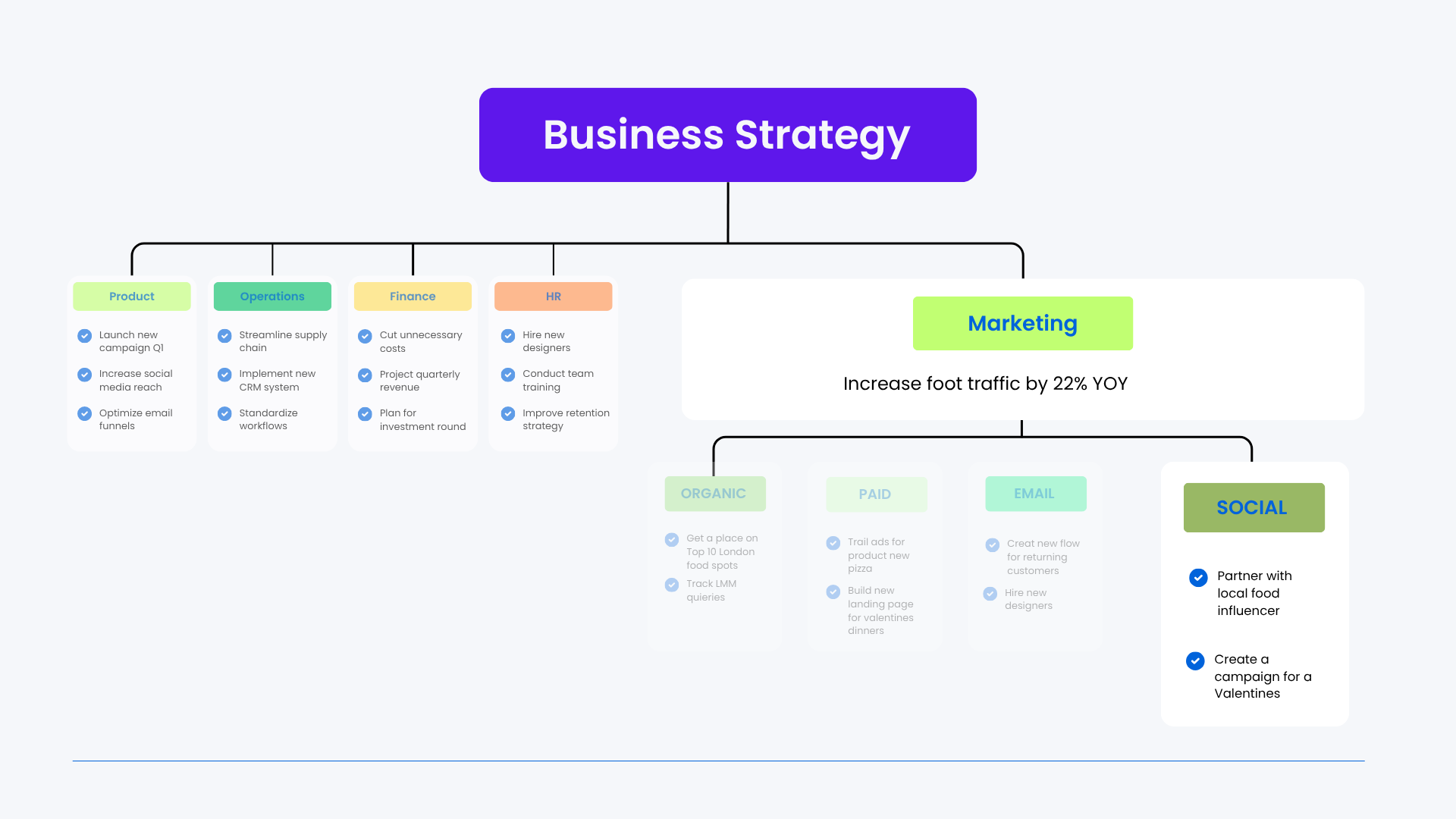
For example, a local gym might have a business goal of increasing monthly memberships. That translates into a marketing objective: Generate more trial bookings.
On social media, the strategy might focus on showcasing classes, community, and results. From there, the KPI becomes clearer:
- Number of bookings driven from social
- Volume of enquiries or DMs
And only then do the supporting metrics come into play — data like reach, engagement and video views.
In this structure, metrics support KPIs, but they don't define them.
4 Meaningful KPIs to Track for Local Brands
So, what should you track? Ultimately, that will depend on the type of multi-location business you are, what tools you have at your disposal, and what platform you're using.
Remember that KPIs might look different on Instagram vs TikTok.
But as a useful benchmark, consider the four social media KPIs below.
1) Local Intent Actions
These are indicators that reflect the closest real-world action. For local brands, this is invaluable, as it often demonstrates the strongest level of digital interest.
Examples include:
- Calls from your social profiles
- Booking enquiries or completed bookings
- Clicks for directions
All of the above demonstrate someone has moved beyond passive interest and is highly likely to take real action.
Note: This type of indicator is based on tracking over the long term rather than expecting impact after every post.
2) Engaged Reach
Reach on its own can be misleading. Just because a reel has 10,000 views doesn't mean that translates into real customers.
Engaged reach tells us a little bit more of the story; it focuses on how many people are paying meaningful attention, not just how many are exposed to your content.
Signals of engaged reach include:
- Saves (content worth coming back to)
- Shares (content worth passing on)
- Content replays
These are stronger indicators that your content is resonating more than just views or video plays.
This KPI is especially important on discovery-led platforms, where visibility is high but attention is limited.
3) Community Interaction Rate
If you work in marketing, you've probably heard the buzz term "community-led" a multitude of times in the last couple of years.
This is where your audience shifts from passive viewers to active participants.
Examples include:
- Direct messages and enquiries
- Tagged posts and mentions
- Comments that show intent, curiosity, or conversation (not just reactions)
- User-generated content
These interactions are often less scalable because they rely on people in your community to interact with your company. But they are much more meaningful than views alone. They indicate trust, familiarity, and a willingness to engage with the brand on a deeper level.
Not just that, but they also act as a trust metric to people outside of your community.
4) Repeat Attention
Most social media reporting focuses on new engagement — for example, how many people saw your post for the first time?
But local brands rarely grow for one-time exposure; they also need familiarity and repetition. This is unlike e-commerce, which can grow successfully through many one-time purchases if they maintain enough engagement.
Indicators might look like:
- Returning viewers across posts
- Repeat profile visits
- Followers
- Regular and consistent engagement
These signals show that your brand is building recognition and staying relevant in people's minds.
Keep Yourself on Track With Meaningful Social Media KPIs
Local social media performance has never been more measurable, but knowing what data not to track is equally important in 2026.
For local brands, especially, the challenge isn't accessing data. It's knowing which social signals actually reflect local SEO and real-world impact — and how to track this in one single dashboard.
When you start with the customer, consider the strategy, and understand the platform, measurement becomes a lot simpler. Not necessarily easy, but clearer.
In the end, metrics are only useful if they help you to understand people. So next time you're feeling flustered with your head stuck in a dashboard, remember to take a step back and think of the bigger picture.



1,800 brands trust us to stay visible
— not just show up once or twice in local search.

.png)
